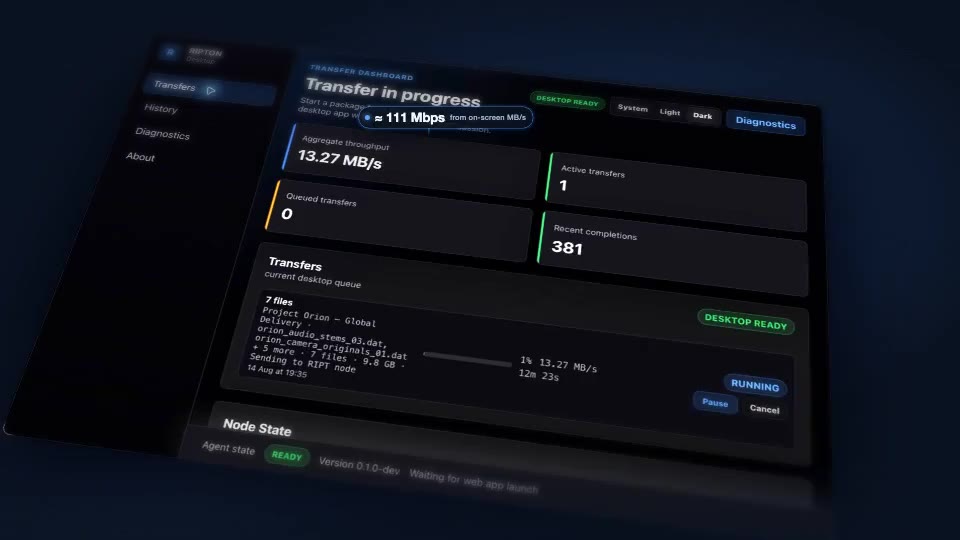
Distance changes the equation.
Latency, packet loss and congestion can reduce transfer throughput—even on a high-bandwidth link. The route, endpoints and transport configuration all matter.
Transfer with confidence.
Built for difficult networks.
Move massive files faster across difficult networks. A secure transfer platform with a desktop experience your team can use without touching a command line.
The challenge
Difficult networks should not define what your team can deliver.
Understand accelerated transferLatency, packet loss and congestion can reduce transfer throughput—even on a high-bandwidth link. The route, endpoints and transport configuration all matter.
A single large file and a directory of thousands of small files place different demands on storage and transfer tools. Evaluate the files your team actually moves.
Speed is only part of the job. Your team also needs clear access controls, encryption and transfer records it can review.
The platform
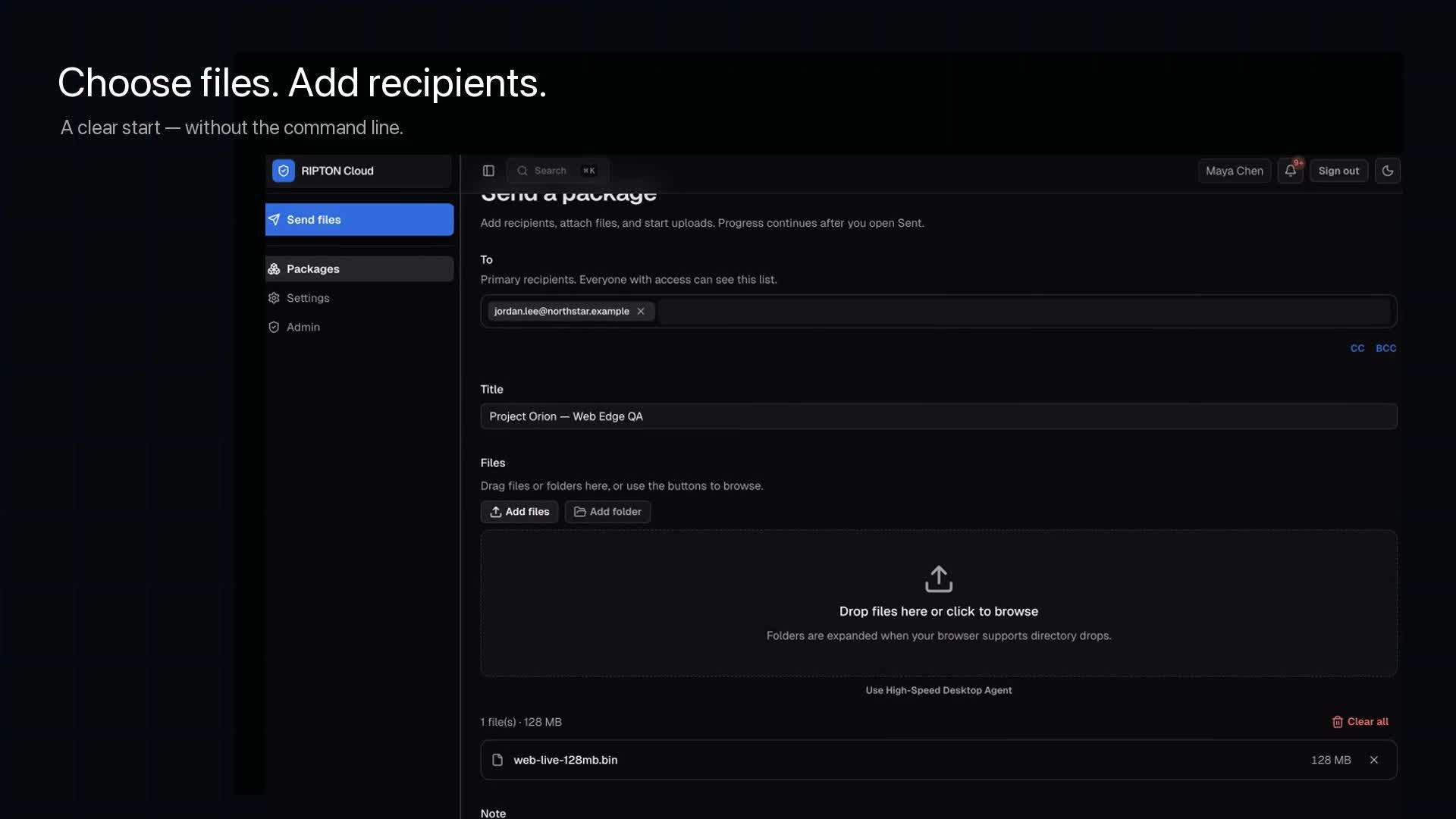
Prepare a package, choose recipients and move your work through Ripton Cloud. Start with a clear browser workflow, with Ripton Desktop for demanding local transfers.
Explore the browser workspaceRipton Cloud is built to use the bandwidth you're already paying for, even across high-latency and lossy links where ordinary TCP transfers slow down.
Published EC2 test at 150 ms and 3% loss: a 1 GB file 7.5x faster than TCP; your proof of concept measures the actual path.
Every packet is individually encrypted and authenticated. New keys are derived for every session. There's no way to accidentally run without encryption — the protocol doesn't allow it.
Mandatory encryption, authenticated packets, and replay protection on every transfer.
Flat plans include a clear monthly transfer envelope. Any overage is priced in advance, so high-volume teams can forecast the bill before they move a byte.
Published plan prices, annual savings, and no seat charge for external guests.
In EC2 tests with simulated latency and packet loss, Ripton Cloud beat the TCP baseline on both large-file and tiny-file workloads.
Large file
7.5x faster
The same 1 GB transfer finished in minutes instead of half an hour.
Tiny-file directory
176x faster
File-heavy transfers avoid the per-file overhead that makes classic workflows crawl.
Tested between two EC2 instances with a netem-simulated impaired network: approximately 150 ms latency and 3% packet loss.
Benchmark your own transfer path →Estimate transfer time →
How to read this and any other benchmark: five questions to ask. The workloads above are the ones behind send large files and large directory transfer. Run the same test on your own route in a two-week proof of concept, or see how we compare with alternatives.
You do not need a perfect technical spec to start. Give us the transfer path, the current pain, and the tool you use today.
Tell us what moves, where it goes, and what feels slow. Exact file counts help, but they are not required.
We compare Ripton Cloud against your current path or a representative workload with the same shape.
If Ripton Cloud is meaningfully faster, choose the plan that fits. If not, you know quickly.
Start with a rough answer: what you move, from where to where, and how long it takes today.
Move camera originals, editorial turnovers, VFX packages, and masters between prepared endpoints. Evaluate Ripton Cloud on the route and workload your production actually depends on.
When dailies need to cross continents, the schedule should not be held hostage by a lossy path.
See media use cases →Named cryptography, authenticated packets, replay protection, and transfer records your security team can inspect.
AES-256-GCM or ChaCha20-Poly1305, negotiated at session handshake. AEAD seals both the payload and the 24-byte header via AAD. There is no configuration to disable encryption.
X25519 ECDHE generates a new shared secret per session. HKDF-SHA-256 derives directional keys and IVs. Compromising one session reveals nothing about past or future sessions.
Per-subflow replay windows (4,096 packets). Monotonic packet sequence enforcement. AEAD authentication detects any modification — bit flips, truncation, injection.
Structured logs with transfer IDs, session IDs, and custom tags. No key material in output. Every session start, completion, and error is timestamped with correlation IDs.
Ripton Cloud keeps the security story concrete:
Cryptographic design summary available for technical review.
Request the cryptographic design summary →Install, configure, and run your first transfer in 10 minutes.
Read →RIC, RINS, rnode, control plane — how the components fit together and where they deploy.
Read →Algorithms, key derivation, nonce construction, replay protection — everything your security team needs.
Read →Send a folder from a browser, set up a Shared Inbox for vendors, share a passcode link, wire webhooks, automate with the CLI.
Read →Why transfers slow down over distance, what UDP acceleration is, how resume works, and how to send 100 GB.
Read →Session management, job status, health checks, metrics — every endpoint documented with examples.
Read →When we publish performance numbers, we include the test environment, exact commands, and network conditions. You can run the same test yourself.
The transfer engine runs go test -race in CI. Fuzz-tested parsers. No known data races in the critical path.
We publish the algorithms, key derivation chain, and nonce construction we use. Your security team can review it before you buy.
Published prices, clear included capacity, and no charge for external guests. Annual plans include two months free.
For evaluation and occasional secure transfers
Included capabilities
For small teams running repeat transfer workflows
Included capabilities
For production teams that need automation and control
Included capabilities
For larger and regulated operational teams
Included capabilities
For custom, air-gapped and multi-site deployments
Included capabilities
Named users include administrators and other full login accounts. Package recipients, delivery recipients, and shared-inbox invitees use scoped guest access and never consume a seat. Why we do not charge for the people you send to →
Some plan limits, such as shared-inbox counts, are not yet enforced automatically in the product; they describe what each plan includes. Transfer overage is disclosed in advance and never interrupts an in-progress transfer.
Taxes are calculated from the billing address. Stripe invoices include collected business tax IDs.
Evaluate Ripton Cloud with your workload, endpoints, and network conditions.